
Smart Facility Management: 3 Great Ways to Calculate ROI
Mostbet’e Nasıl Kayıt Olunur
May 12, 2022Pin Up casino: Официальный сайт ПинАп казино играть онлай
July 3, 2022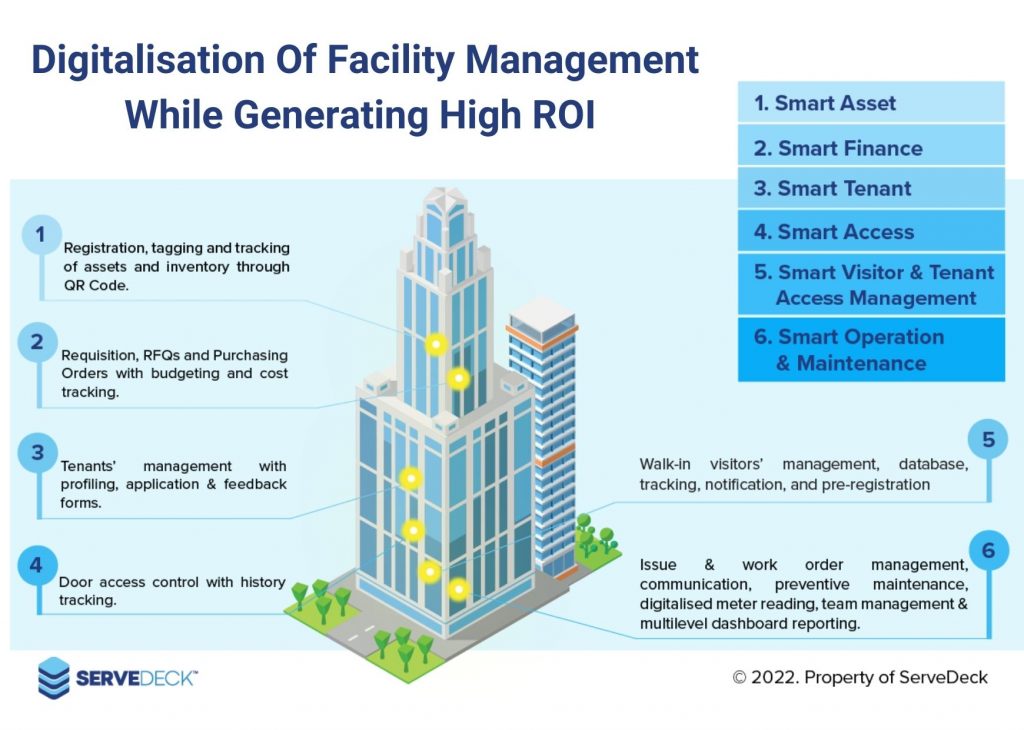
Facility Management roles are traditionally covering buildings’ services management, making sure that buildings are operating, maintained, always secured and compliant.
However, buildings, or CRE (Commercial Real Estate), are also a prime grade investment asset which need to guarantee a stable, and possibly raising, return on investment to their owners. This is a rarely looked at deliverable of facility management companies and often cause of discussions and disputes between asset owners and facility management professionals.
With the current pace of technology growth and, with tenants and users expecting more and better building functionality, an omni-channel approach looks more appropriate and effective for successful facility management.
All the various functions, equipment and teams shall be onboarded, together with the end users of the building, on a fully integrated and, possibly, cloud-based system enabling real-time management of the whole. This new approach, already popular in western markets, is just starting in Southeast Asia and represents the correct way of adopting, maybe in multiple phases, a Total Facility Management Smart Solution rewarding all involved parties with high ROI.
Let’s go through the highlights and calculation of short, medium and long-term ROIs resulting from an omni-channel smart facility management system implementation. Understanding the advantages of a total digital adoption will allow, first, to make the decision based on facts and numbers instead of assumptions and, secondly, to be ready to defend the requested budget with strong arguments.
Preventive Equipment Maintenance
Preventive maintenance is not new to all facility managers but, enforced in the traditional way, still generates extra costs in inventory, manpower and downtimes. Even worst, it doesn’t provide “guaranteed” zero downtimes. Traditional way means, defining timeframes for “preventive” maintenance of a chiller, as example, based on its performance track of record. In other words, we look at the past to assume the future with no guarantees that our engineer is spending hours and resources at the right time and, even worst, without any guarantee that the chiller will not cause an emergency for failure just few hours after the last preventive maintenance intervention.

One of the aspects, often forgotten, of a total facility management digitalisation, is the continuous data collection and storage. A proper data analysis, combined with an IoT device connected to the chiller, following the example above, will allow the facility manager and the engineer to have the “heartbeat” of the chiller always under control deciding when the best time for a maintenance intervention is and which ones, of the many components of the chiller, will need to be replaced.
In this way preventive maintenance should be renamed as targeted maintenance and, as a result, the bottom line costs of it, once applied to all the equipment in a building, will substantially drop.
ROI calculation of the above could be the resulting ratio between the total Over Time costs of the technical department plus the inventory cost divided by the subscription cost of the digital facility management solution implemented.
Resources Management
When using the traditional way to manage resources, a facility manager, once more, will define tasks, time frames, inventories and more based on few data collected, assumption and “experience”.
The result of this could be to have the right team in the wrong place at the wrong time and, consequently, to generate waste of time-costs, unsatisfaction in the building’s end users and, frustration within the team.
Realtime data collection allows to define path and recurrences and plan different facility management teams’ actions accordingly. As an example, we look at housekeeping in either a hotel or office tower.

The traditional way sees at least two to three people allocated every two to three floors waiting for guests/users to move out from their room/office to perform their housekeeping duties. They do not know when the guests/users are moving out and randomly knock at doors often getting a harsh reply from inside the room or office. Result is, manpower is often underutilised, and guests/users’ experience cannot be defined as good.
With IoT applied in the room/office and connected to a data collection centre and “control room”, the place where the facility manager of a digitalised future should sit, it will be possible to direct the housekeeping team towards vacated rooms/offices allowing a great saving of time and creating a pleasant experience for guests and users that will never been “annoyed” by the knocking at the door.
Savings in this case could go up to more than 30% of housekeeping manpower cost, depending on the size of the building or number of rooms and team headcount. At the same time, end-users’ experience will also be improved providing return in terms of positive reviews and recommendations for both office tower or hotel and facility management company.
Communication Management
Another area positively enhanced by digitalisation is communication; within the teams and the facility manager as well as between the facility management teams and the end-users.
We are aware of how time costing and non-productive are all the team briefing/coordination. Every participant needs to get ready with a report and, during the meeting, to update the status of each work order.
With digital system, on the other hand, work status as well as attendance, issues, or inventory status, are updated and can be monitored in real-time by all participants. With the right digital system in place, team coordination can be done in a much faster, more strategic, and effective way.

By direct experience, each team spend 30-45 minutes each day on all the above; multiply by the number of heads and is possible to easily calculate the saving and related ROI.
Conclusions
The ROI calculation referred to the adoption of a digitalised solution for facility and operation management, should always be carried out by thinking at how the chosen solution will contribute, and consequently reduce costs / generating ROI, to:
- Managing resources
- Managing manpower
- Managing inventories
- Managing and controlling budget
- Increase efficiency
- Raise the quality of services to the building’s users (in the long term this will generate higher rentals and full occupancy)
- Increase the users’ experience when inside the building
Much more could be said, and calculated, in terms of ROI from adoption of a Total Facility Management Digital Solution but, one important thing to always remember is how to choose the right one and, if to choose a commercial product or opting instead for a tailor made one.
There are several choices that a facility manager could be looking at, however, it could be helpful to get in touch with ServeDeck’s Business Development Team and ask them for a personalised demo to resolve, one by one, all your challenges. Additionally, this blog might help understanding the main differences and Pros & Contras between commercial products and tailor-made solutions.
ServeDeck has been helping hundreds of asset owners and facility managers finding their way in the FM Digitalisation journey and is ready to help you in the definition of your needs, providing the right solution for your challenges and guaranteeing a 5 stars service in the implementation process without forgetting an outstanding technical support in the aftermath of your digital transformation adoption.
Connect with us via email at info@servedeck.com or request a free demo here.
ABOUT THE AUTHOR

The opinions expressed in this article are solely of the author, Dr Daniele Gambero.
Dr Gambero has been an expatriate to Malaysia from Italy, since 1998 and has more than 35 years of real estate experience. He is the co-founder and group CEO of REI Group of Companies, the Co-founder of Propenomy.com and the deputy president of the Malaysia Proptech Association.
In the past 10 years Daniele, as international and TEDX speaker, has engaged several hundreds thousand people talking about Property, Economy, Propenomy, Digital Marketing and Motivation. He is also a bestselling author and columnist on several magazines and main stream media. You can reach him directly through his LinkedIn page here
